
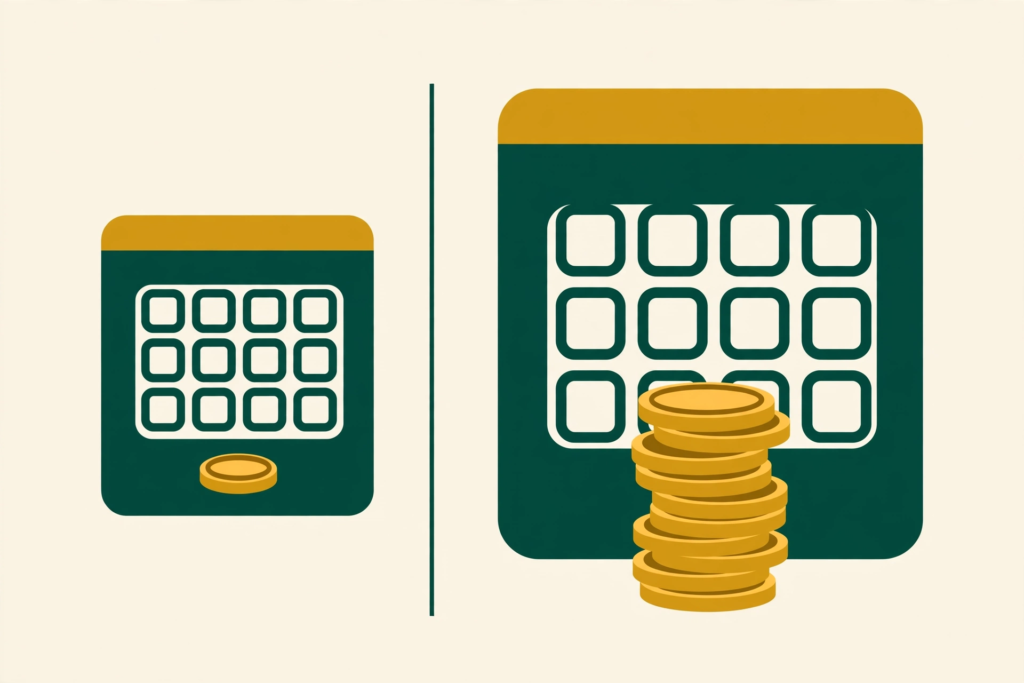
When you buy life insurance, the application asks how you want to pay: monthly, quarterly, semi-annually, or annually. It feels like a minor administrative choice, but the pay life insurance monthly vs annually decision affects your total cost every year you own the policy. Annual payers save a meaningful percentage; monthly payers gain cash-flow flexibility. Here is how to decide.
The Price Difference: Modal Factors Explained
Insurers price policies on an annual premium, then apply “modal factors” for more frequent payments — multipliers that make installments cost more than the annual amount. Typical 2026 modal factors:
Pay life insurance monthly vs annually at a Glance
Should you pay life insurance monthly vs annually? Annual billing saves 3-8% per year. Compare modal factors, costs, and which payment mode fits your budget. Below, we break down pay life insurance monthly vs annually in detail so you can act with confidence.
Table of Contents
- Annual: 1.00 (baseline — no surcharge)
- Semi-annual: 0.52 per payment (1.04x annual total)
- Quarterly: 0.265 per payment (1.06x annual total)
- Monthly: 0.09 per payment (1.08x annual total)
On a $600/year policy: annual billing costs $600, while monthly billing costs $54/month × 12 = $648 — an extra $48/year, or 8%. On a $4,800/year whole life premium, monthly billing adds roughly $290–$385/year.
Why the surcharge? Two reasons: the insurer loses investment income on money received later in the year, and installment billing costs more to administer. The factors are filed with state regulators — they are not negotiable, but they are avoidable.
Over a 20-year term, the 8% modal surcharge on a $600/year policy totals $960 in extra payments. On a $5,000/year permanent policy over 30 years, it exceeds $10,000. Small percentages compound into real money over decades.
The Case for Annual Payment
You save 3–8% every year. This is free money — identical coverage, lower price, no trade-off except timing. For anyone with the cash flow to handle it, annual is the mathematically correct choice.
Fewer chances to miss a payment. One payment per year means one deadline to track instead of twelve. Policies lapse because of missed monthly payments far more often than missed annual payments — fewer touchpoints, fewer failures.
Simpler administration. One transaction, one receipt, one record for tax files. If you ever need to prove continuous coverage, annual billing creates the cleanest paper trail.
Better for large premiums. The bigger the premium, the bigger the dollar savings. On whole life premiums of $5,000–$10,000/year, annual billing saves $150–$800 annually — worth prioritizing.
The main requirement: discipline to set aside 1/12 of the premium monthly in a savings account so the annual bill does not strain cash flow. Many annual payers automate a monthly transfer to a dedicated sub-account — capturing the discount without the lump-sum shock.
The Case for Monthly Payment
Cash-flow smoothing. A $400/month premium is manageable for many budgets; a $4,444 lump sum (annual equivalent) is not. If annual billing would force you onto credit cards or drain emergency savings, monthly is the responsible choice — an 8% surcharge beats 24% credit card interest.
Easier budgeting. Monthly premiums align with monthly income and monthly bills. For households running tight budgets, predictability matters more than optimization.
Lower barrier to buying. Some buyers delay purchasing because the annual premium looks intimidating. A $65/month quote gets a “yes” where a $722 annual quote gets “let me think about it.” Coverage in force at monthly rates beats perfect optimization that never happens.
Employer alignment: If premiums are payroll-deducted (common for supplemental group life), monthly is automatic and effortless.
The honest framing: monthly billing is a financing plan. You are paying the insurer ~8% APR to spread payments across the year. That is not terrible — it is cheaper than most credit — but recognize it as a cost, not a default.
The Middle Grounds: Quarterly and Semi-Annual
Quarterly (6% surcharge) and semi-annual (4% surcharge) split the difference. They make sense in specific situations:
- Semi-annual works well for people paid on irregular schedules (contractors, seasonal workers) who get large payments twice a year.
- Quarterly suits quarterly-bonus employees or business owners who true-up finances each quarter.
Neither is optimal on pure cost — annual wins — but both beat monthly if annual is unworkable. Think of payment frequency as a sliding scale: pay as infrequently as your cash flow comfortably allows.
Special Considerations
Automatic bank draft (EFT/ACH): Regardless of frequency, set up automatic payments. Lapses from forgotten payments are the most preventable failure in life insurance. Most insurers offer a small additional discount (or at least waive billing fees) for EFT.
Credit card payments: Some insurers accept credit cards for monthly premiums — tempting for points, but watch for convenience fees (2–3%) that erase the rewards. Never carry a balance to pay life insurance premiums; the interest dwarfs any modal savings.
Modal changes mid-policy: You can switch payment modes at policy anniversaries (and sometimes mid-year). If your cash flow improves, call the insurer and switch from monthly to annual — the savings start immediately. There is usually no fee for the change.
First-year premiums: Many policies require the first premium with the application (often two months’ worth for monthly mode). Plan for this initial outlay regardless of mode.
The Decision Framework
Ask yourself one question: can I comfortably pay the annual premium from savings without touching emergency funds or using credit?
- Yes → pay annually. Bank the 3–8% savings every year.
- Barely → pay semi-annually or quarterly. Capture partial savings without strain.
- No → pay monthly, automatically. The surcharge is the price of keeping coverage affordable month-to-month — and coverage you can sustain beats optimal coverage you cancel.
Revisit the decision when finances change. The freelancer who needed monthly billing at 32 may easily handle annual billing at 40 — but only if they remember to switch.
How much do you save paying life insurance annually?
Typically 3–8% per year versus monthly billing, depending on the carrier’s modal factors. On a $1,200/year term policy, that is $36–$96/year; on a $6,000/year whole life policy, $180–$480/year. The savings compound over the policy’s lifetime.
Can I switch from monthly to annual payments later?
Yes. Most insurers allow payment-mode changes at any time or at policy anniversaries, usually with a simple form or phone call. The new mode’s pricing applies going forward. There is typically no fee to switch.
Is monthly life insurance more expensive at all companies?
Virtually all insurers apply modal factors — it is industry-standard pricing, not a company quirk. The exact factors vary slightly by carrier (monthly totals range from ~1.05x to ~1.09x annual), so the penalty differs modestly between companies.
What happens if I miss a monthly premium payment?
Your policy enters its grace period (typically 30–31 days) during which coverage continues. If you pay within the grace period, nothing happens. If not, the policy lapses — though term policies can often be reinstated within a few years with back premiums and proof of insurability.
Want the full picture on pay life insurance monthly vs annually? Start with the National Association of Insurance Commissioners for the official facts, then work through the related guides below for actionable next steps.
Shopping for pay life insurance monthly vs annually? Start by comparing quotes from at least three insurers — families who compare save significantly on pay life insurance monthly vs annually every year.